
A depreciating rupee, which briefly hit 80 to the dollar on Tuesday, may boost India's exports but price-inelastic imports of crude oil and gold would mean limited relief on the trade deficit, which clocked a record $26.2 billion in June. Due to global risk aversion on the back of geo-political tensions and aggressive policy tightening by the Fed, the dollar has appreciated against most currencies, including the rupee. And, with other currencies depreciating, India's comparative advantage in this respect may be limited.

Trends in the global markets, trading activity of foreign investors and announcement of domestic macroeconomic data are the major factors that would drive investors' sentiment in a holiday-shortened week ahead, analysts said. Benchmark indices had a record-breaking rally in the past week driven by impressive GDP data. Equity markets would remain closed on Friday for Mahashivratri.
The change will help companies address market rumours without being worried about the impact on deal pricing.
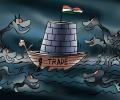
With Kabul falling into the hands of the Taliban, bilateral trade between Afghanistan and India will get impacted significantly in these uncertain times, according to exporters. Federation of Indian Export Organisations (FIEO) director general Ajay Sahai said domestic exporters should follow caution looking into the political development in Afghanistan, particularly with regard to payments, for which adequate credit insurance may be availed by them. "The trade will be impacted. It would reduce due to the growing uncertainty in Afghanistan," he said on Monday. Former FIEO president and country's leading exporter S K Saraf too said there will be a significant fall in the bilateral trade.

A day after lambasting e-commerce players for predatory pricing, Union Commerce Minister Piyush Goyal on Thursday said he is not against online platforms but India wants such entities to be "fair and honest" in their conduct. Speaking with reporters in the financial capital, the outspoken Union minister said the rule of the law should be followed in letter and spirit, and made it clear that consumer preferences should not be influenced by algorithms.

Mutual funds aspirants have the option of snapping up smaller AMCs or applying for a new licence.
Indian exporters shipping goods to Israel may face higher insurance premiums and shipping costs due to the Israel-Hamas conflict, according to experts. Israel witnessed a surprise and unprecedented multifront attack by air, land and sea by the Hamas militant group, which rules the Gaza Strip, in its southern parts on Saturday morning. The International trade experts said the conflict may reduce the profits of domestic exporters but will not impact trade volumes unless war escalates.

The index is currently trading at 149 per cent of its historical P/B valuation, surpassing its previous peak of 125 per cent made in 2020-21.

India, the US and 12 other members of the IPEF grouping have signed a supply chain resilience agreement that would help mitigate risks of economic disruptions from supply chain shocks and improve crisis coordination. The agreement would help member countries like India to reduce their dependence on China and provide timely information to the IPEF member countries about potential supply disruptions. The COVID outbreak severely disrupted the global supply chain, as most countries were dependent on China for various products like pharma raw materials.

Equity benchmark indices Sensex and Nifty hit their all-time high levels on Friday helped by impressive GDP data and fresh foreign fund inflows. Also, a rally in global markets added to the positive momentum in the equity markets. The 30-share BSE Sensex jumped 1,139.04 points to 73,639.34 -- its all-time peak -- in the late afternoon trade.

Any government support or incentive to help exporters deal with high freight and insurance costs is unlikely.

The BSA Gold Star is launched....Ola Enters e-motorbikes Biz... Bajaj, TVS To Enter e2Ws Market...

In India, fast-moving consumer goods (FMCG) majors continue to hold sway, with incumbent brands cornering 65 per cent of the market share, shows a Bain & Company report. While identifying the continued preference of Indians for incumbent brands, the report says that the dominance of general trade in the country has allowed national brands to maintain their supremacy. The low penetration of e-commerce in the country has also helped large brands.
Global financial markets are wrong in hoping that the worst is over in geopolitical crises such as the Iran-Israel conflict and the Russia-Ukraine war, wrote Christopher Wood, global head of equity strategy at Jefferies, in a recent note to investors called 'GREED & fear'. While most investors and the media are focused on United States (US) Federal Reserve policy and the "endless chatter" of Fed governors, Wood believes the news flow in the financial sphere "pales into complete insignificance" compared with the "tectonic shifts" going on in geopolitics.

Escalation of the conflict in West Asia between Israel and Iran has had a direct impact on the energy markets, and more broadly on the financial markets as well as the global economy.

Shigeru Ishiba is expected to prioritise strengthening Japan's military capabilities and fostering deeper international partnerships, particularly with India, with whom Japan shares significant strategic interests, explains Dr Rajaram Panda.
ITC has extensively reset its strategy and will explore opportunities to craft disruptive business models to set up structural drivers helmed by digital and sustainability for its next horizon of growth and make the company future-ready, chairman Sanjiv Puri said on Wednesday. The company is pursuing an accelerated journey to build a dynamic utureTech' enterprise by investing in cutting-edge digital technologies to shape a new paradigm of competitiveness, create innovative business models and tap newer opportunities, he said while addressing shareholders at ITC's virtual annual general meeting. As part of the next horizon vision, the company is "proactively exploring inorganic opportunities" even as it has shrunk "business segments that were incongruent to our growth aspirations, such as the Lifestyle Retailing Business" while the existing growth platforms comprising megabrands will be scaled up and fortified.

Security agencies at Mumbai's Nhava Sheva port intercepted and seized the consignment of a Karachi-bound ship from China after it was found carrying a dual-use consignment with implications for Pakistan's nuclear and ballistic missile programmes.
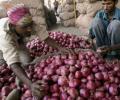
However, truckers have spared other vegetables, fruits, fuel and milk from the strike.

'In the audience's mind there is no urgency to go see a film in the theatre.' 'If you pay for social media buzz it does not convert into bums on seats.'
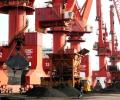
Huge demand for dry bulk commodities such as iron ore, coal, and grain has helped the Index touch a five year high recently.

'Valuations of midcaps and smallcaps have reached very high levels, and hence to that extent leave little margin of safety.'
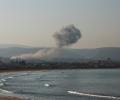
In days of smart, networked technology and no shame over collateral damage, what will blow up next -- cars, mobile phones, TV sets, refrigerators? And where?, asks Shyam G Menon.

In a statement issued on Saturday, Austin said that the US and the UK also received support from Australia, Bahrain, Canada, Denmark, the Netherlands and New Zealand in conducting the additional strikes.

The country's largest stock bourse NSE on Friday said it stuck to the primary site for carrying out trading on Wednesday and did not switch to the disaster recovery site after a considered view while dealing with telecom connectivity issues which led to the nearly four-hour halt in trading earlier this week. It can be noted that Sebi had asked the exchange, which also trades the highest derivative volumes in the world, as to why it did not switch to the Disaster Recovery (DR) site. "Post shut down of trading on NSE, we considered all the available alternatives on hand including invocation of DR to decide on the course of action that would bring up the market at the earliest with least disruption to market participants and post evaluation, a decision was taken to bring up the systems at the primary site," a statement from NSE said.

There was no smooth surge in middle class prosperity for foreign businesses to tap into because of the Indian economy was mismanaged, argues Debashis Basu.

The exchange cited issues with its telecom service providers that prevented stocks and index quotations from getting updated.

Among the Sensex firms, Kotak Mahindra Bank, UltraTech Cement, Mahindra & Mahindra, Larsen & Toubro, ICICI Bank, IndusInd Bank, Wipro and Hindustan Unilever were the major laggards. Sun Pharma, Bajaj Finance, Bharti Airtel, Reliance Industries, Bajaj Finserv and Titan were among the winners.

There have been growing global concerns over China's sweeping claims of sovereignty over all of the South China Sea, a huge source of hydrocarbons.

There is no direct impact of the Russia-Ukraine crisis on India in terms of bilateral trade but a surge in oil prices poses considerable risk to the economy, an analyst report said on Friday. International oil prices which have surged past $100 per barrel "pose risks to external stability and currency movement," a Bank of Baroda Economics Research report said. Russia has launched military operations against Ukraine, stoking fears of significant disruption in the region, including loss of life. The West is ramping up financial sanctions against Russia and support for Ukraine.

The second round match between former champion Angelique Kerber and Anhelina Kalinina, originally scheduled to begin after Schwartzman and Anderson, was pushed to Thursday.

Prices may go up because of higher energy costs, caused by the rise in shipping charges, with commercial vessels taking a longer route to avoid the troubled Red Sea region, the finance ministry said on Monday. Iran-backed Houthi rebels of Yemen are repeatedly attacking ships in the Red Sea. While the global economy is grappling with challenges such as sticky inflation, sluggish growth, and mounting fiscal pressure, India's external sector could face "potential risks" due to the ongoing geopolitical tensions, according to the finance ministry's report on the review of the Indian economy.
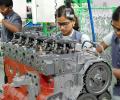
Genset manufacturer Cummins India has seen its share price rise by 45 per cent in the past three months. The management has reaffirmed that growth would be in double digits over the coming two fiscal years. Growth is expected to be driven by a pickup in domestic infrastructure spending.

India, Jaishankar said, is a "prisoner of its past image" and must get over it.

The Bombay Stock Exchange has resumed trading after three hours on Thursday.

The National Stock Exchange (NSE) on Monday said failure of telecom links as well as that of storage area network system led to the outage last month and that steps are being taken to address the issues. Between primary and NDR (Near Disaster Recovery) sites, NSE said it has multiple telecom links with two service providers to ensure redundancy. In a detailed statement on the outage that happened on February 24, the bourse said various measures have been taken and others are under implementation to address the issues.

If the war in the Israel-Gaza region escalates into a larger West Asian conflict, it could pose problems.

Since March 2020, when the Nifty50 plummeted to 7,511 following the announcement of a nationwide lockdown, the stock market has been on an upward trajectory. Over the next four years, the major market index has delivered a remarkable compounded annual growth rate (CAGR) of over 31.5 per cent. In the past year alone, the Nifty50 has gained by 27 per cent, hitting a succession of record highs.

The trade impact of the coronavirus epidemic for India is estimated to be about 348 million dollars (approximately Rs 25 billion) and the country figures among the top 15 economies most affected as slowdown of manufacturing in China disrupts world trade, according to a UN report. Estimates published by United Nations Conference on Trade and Development on Wednesday said that the slowdown of manufacturing in China due to the coronavirus (COVID-19) outbreak is disrupting world trade and could result in a 50 billion dollar decrease in exports across global value chains.

Regulators must learn from past mistakes and act swiftly to prevent Big Tech from monopolising the AI ecosystem, argue Payal Malik and Nikita Jain.
